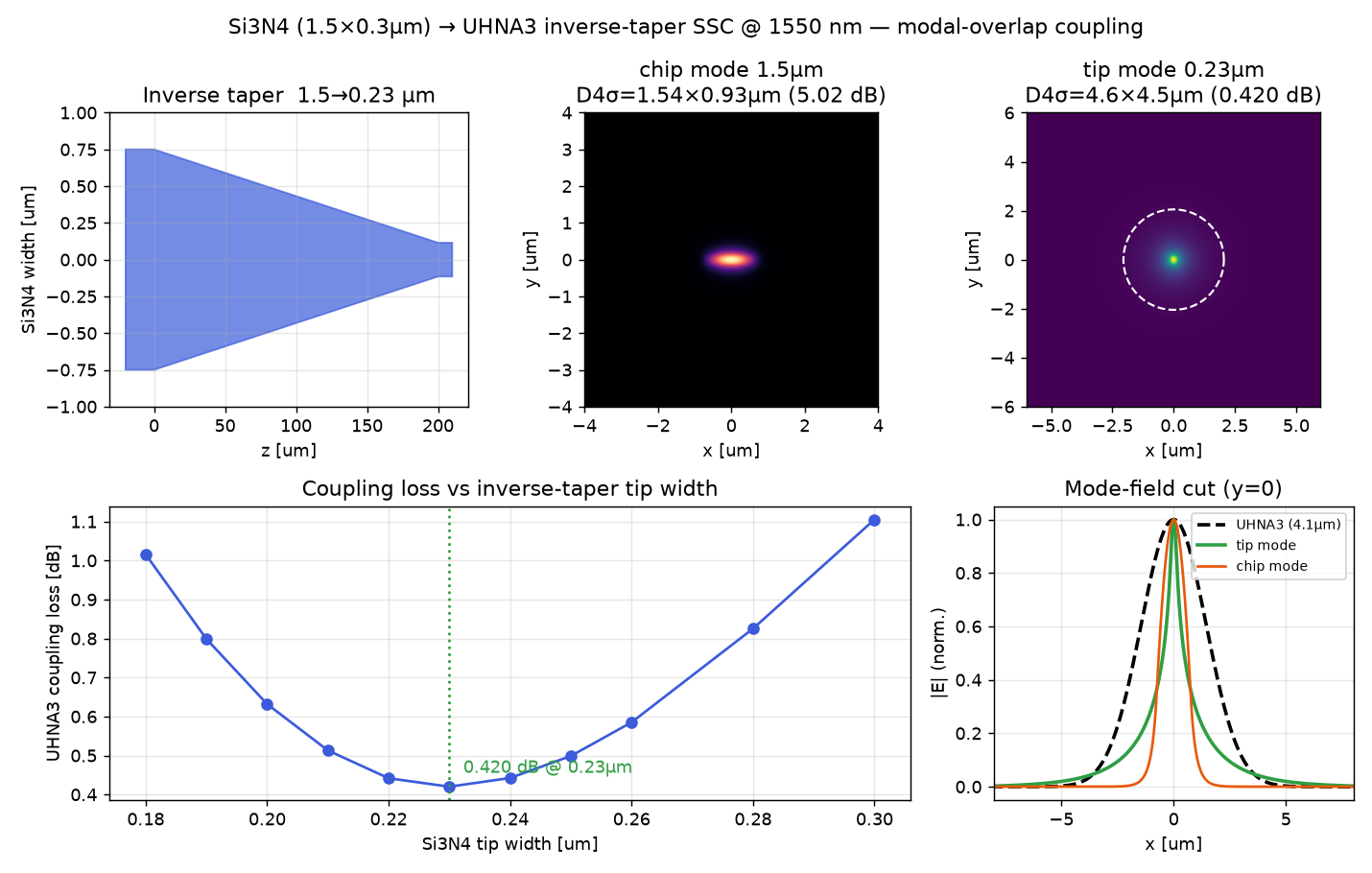
Si₃N₄ 1.5 × 0.3 µm core (3 µm thermal SiO₂ BOX, 5 µm SiO₂ top clad) ↔ UHNA3 ultra-high-NA fiber at 1550 nm — an inverse taper delocalizes the mode to match the fiber. Coupling loss 0.42 dB (mode-overlap integral), down from 5.0 dB bare.
Platform & fiber parameters
UHNA3 (Nufern) is an ultra-high-NA fiber: NA 0.35, MFD ≈ 4.1 µm at 1550 nm. The last field is the mode-field diameter the inverse-taper tip presents to the fiber; the tip width is chosen so this ≈ the fiber MFD. Set it equal to the bare-core MFD to see the loss without a converter.
n_core — Si₃N₄ (Luke Sellmeier)
—
n_clad — SiO₂ (Malitson Sellmeier)
—
Fiber Gaussian waist w₀ = MFD/2
—
Coupling loss — bare 1.5 µm core (FD)
—
Coupling loss — SSC tip ↔ UHNA3 (FD)
—
Gaussian-overlap estimate (tip MFD field)
—
SSC quality
—
The two FD values are the authoritative mode-overlap results from the sparse finite-difference eigensolver (downloads below). The interactive row is a quick Gaussian–Gaussian overlap estimate as you vary the tip-mode MFD.
Mode-field cross-section — blue: UHNA3 fiber Gaussian, red dashed: bare Si₃N₄ core mode (tiny), green: expanded inverse-taper tip mode. Larger overlap with the fiber means lower loss.
Why an inverse taper (high-contrast SSC)
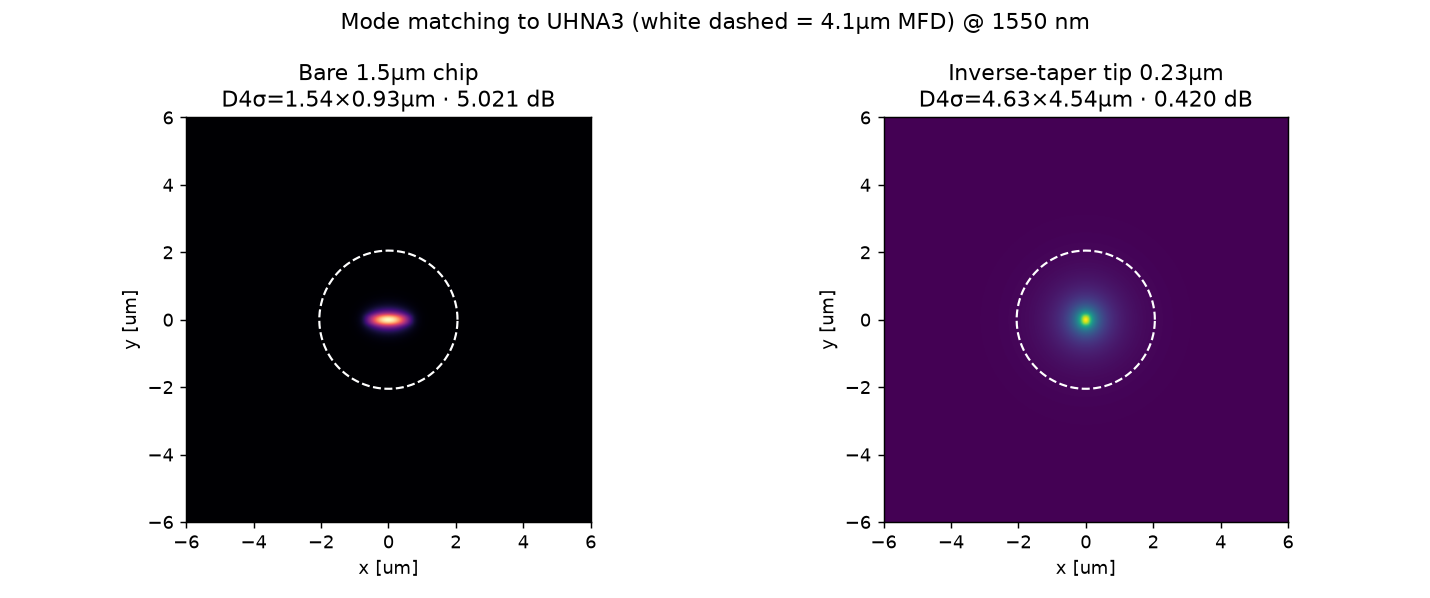
Si₃N₄ (n ≈ 1.996) in SiO₂ (n ≈ 1.444) is a high index-contrast platform. A 1.5 × 0.3 µm core tightly confines the mode to ≈ 1.5 × 0.9 µm — far smaller than the UHNA3 fiber (MFD 4.1 µm), so the bare butt-coupling loss is a huge ≈ 5.0 dB.
Unlike the low-contrast silica SSCs (which widen the core), the fix here is to make the core narrower: an inverse taper shrinks the Si₃N₄ width toward a sub-wavelength tip. As the width drops, the effective index falls toward the SiO₂ cladding and the mode delocalizes and expands into the oxide.
At the optimal tip width the expanded mode matches the fiber; the taper is made long enough (≈ 200 µm) to be adiabatic, so the device coupling loss equals the tip-mode / fiber mismatch.
UHNA3's small 4.1 µm MFD is chosen deliberately: it sits between the on-chip mode and a standard SMF-28 (10.4 µm), so a short UHNA fiber pigtail bridges Si₃N₄ to SMF with low loss at both ends.
How the coupling loss is evaluated (FD mode overlap)
Butt-coupling loss is the mode-overlap integral between the fiber mode and the waveguide (tip) mode:
η = |∫ E_wg·E_fiber* dA|² / (∫|E_wg|² dA · ∫|E_fiber|² dA), Loss(dB) = −10·log₁₀(η)
The 2-D waveguide mode E_wg is found by solving the scalar Helmholtz eigenproblem (∂²ₓ + ∂²ᵧ)E + k₀²n(x,y)²E = β²E on the real Si₃N₄/SiO₂ index cross-section with a sparse shift-invert eigensolver (largest n_eff); E_fiber is the UHNA3 field (Gaussian, MFD 4.1 µm).
Why not an imaginary-distance BPM mode solve. For a high-contrast Si₃N₄ wire near cutoff, the paraxial imaginary-distance iteration is unstable — it collapses onto a spurious tightly-bound mode. The direct finite-difference eigensolve is grid-convergent and robust, so it is used for the reported numbers.
Result @ 1550 nm — optimal inverse-taper tip
Sweeping the Si₃N₄ tip width and overlapping each tip mode with the UHNA3 field gives a clear minimum. The mode expands monotonically as the tip narrows; the loss bottoms out where the tip mode best matches the 4.1 µm fiber.
Quantity
Value
Coupling loss — inverse-taper tip ↔ UHNA3
0.420 dB (η = 90.78 %)
Coupling loss — bare 1.5 µm core (no taper)
5.02 dB (η = 31.5 %)
Optimal Si₃N₄ tip width
0.23 µm (n_eff = 1.4491)
Tip mode field diameter (D4σ)
4.63 × 4.54 µm
Bare core mode field diameter (D4σ)
1.54 × 0.93 µm
Taper length (chip 1.5 µm → tip)
200 µm (adiabatic)
The optimum is broad — a tip width in ≈ 0.22–0.24 µm keeps the loss under 0.45 dB, giving good lithography tolerance. The residual ≈ 9 % (0.42 dB) is the intrinsic shape mismatch between the near-cutoff waveguide mode (peaked centre, exponential tails) and the fiber's Gaussian; even when the D4σ matches, the overlap is capped near 91 %. The 3 µm thermal-oxide BOX is assumed thick enough that substrate leakage of the ≈ 4.6 µm tip mode is negligible.
Si₃N₄ → UHNA3 inverse-taper SSC @ 1550 nm — taper geometry, the tightly-confined chip mode (1.5 × 0.9 µm) and expanded tip mode (4.6 × 4.5 µm), coupling loss vs tip width (minimum 0.420 dB at 0.23 µm), and a y = 0 mode-field cut against the UHNA3 field.Mode matching to UHNA3 (white dashed = 4.1 µm MFD): the bare 1.5 µm core mode (1.5 × 0.9 µm, 5.02 dB) badly under-fills the fiber, while the inverse-taper tip mode (4.6 × 4.5 µm, 0.420 dB) fills it.
Downloads
Everything needed to reproduce the result above:
ssc_optimized.gds — Si₃N₄ inverse-taper mask (1.5 µm chip → 0.23 µm tip over 200 µm, layer 1).
ssc_reference.gds — the bare straight 1.5 µm Si₃N₄ waveguide (no converter).
run_sin_uhna3_ssc_1550.py — driver: sweeps the tip width, finds the optimum, computes the UHNA3 mode-overlap loss, and writes the GDS + figures.
fdmode.py — the sparse finite-difference scalar mode solver (Si₃N₄/SiO₂ index builder, Helmholtz eigensolve, overlap & D4σ helpers).
Run with python3 run_sin_uhna3_ssc_1550.py --out . (needs numpy, scipy, gdstk, matplotlib). Coupling loss is the mode-overlap integral between the eigensolver's 2-D waveguide mode and the UHNA3 field; pass --dx 0.018 --dy 0.013 for a finer convergence check.
Equations
Scalar mode: (∂²ₓ + ∂²ᵧ) E + k₀² n(x,y)² E = β² E, n_eff = β / k₀
Fiber mode (Gaussian): E_fiber(r) = exp(−r²/w²), w = MFD/2
Coupling: η = |∫ E_wg·E_fiber dA|² / (∫|E_wg|² dA · ∫|E_fiber|² dA), Loss(dB) = −10·log₁₀(η)